🎤 Essential Vocal Scale Exercises for Singers
While this Vocal Scales Lesson is free, nevertheless it forms an important part of your vocal foundation. For the best results, we strongly recommend completing the Breath Control lesson before working through this one, because it will therefore help you get more out of the exercises and consequently, develop better vocal awareness.
Indeed, scales are one of the most important tools for singers since they simultaneously train your ear, your voice and your muscle memory. Although many beginners often overlook their value, in fact they remain essential for developing pitch accuracy, vocal control and ultimately, confidence when singing.
In this lesson, you will learn what singing scales are, why they matter and how to practise them effectively. Moreover, you will be guided, step by step, through simple exercises designed specifically for beginners; therefore, no prior musical knowledge is required. All you need is your voice, a little patience and, most importantly, a willingness to practise consistently.
Estimated Time: 10–15 minutes
Level: Beginner
🌟 What You’ll Learn
-
What singing scales are
-
How scales improve your voice and ear
-
How to practise simple scales correctly
-
How to recreate notes with accuracy
-
How to build confidence when singing
💡 Why This Matters
Scales are one of the most important tools in singing because they train multiple skills at once.
When you practise scales, you are:
-
Training your ear to recognise pitch
-
Teaching your voice to move accurately
-
Building muscle memory for singing
Without scales, singing can feel unpredictable and inconsistent.
👉 With scales, your voice becomes more controlled, reliable, and confident over time.
🧠 Key Idea: Scales Are a Vocal Ladder
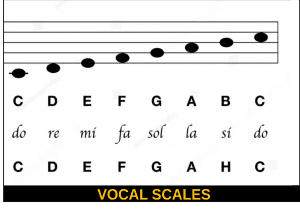
A singing scale is a series of notes moving step by step up and down in pitch.
Think of it like a ladder:
-
Each note is one step
-
You move up and down smoothly
-
You learn how each step feels and sounds
By repeating scales regularly, your brain and voice begin to work together naturally.
🎯 What Scales Help You Develop
Scales help you:
-
Match pitch more accurately
-
Strengthen vocal control
-
Improve tone and consistency
-
Build confidence in melodies
👉 Even simple scales can create powerful improvements.
🧪 Step 1: Prepare Your Voice
Purpose: Gently warm up your voice
-
Breathe in through pursed lips
-
Exhale on a relaxed “Haaaa” sound
-
Repeat 3–5 times
Then:
-
Hum softly on a comfortable note
-
Keep your jaw relaxed
-
Keep lips gently closed
👉 This prepares your voice without strain.
🧪 Step 2: Your First Scale (3-Note Scale)
Purpose: Learn basic pitch movement
Sing:
Do – Re – Mi – Re – Do
You can use:
-
“laa”
-
“oo”
Choose whichever feels easiest.
Tips:
-
Start on a comfortable note
-
Sing slowly
-
Focus on accuracy, not speed
👉 Repeat several times before moving on.
🧠 Step 3: Recreating Notes
Purpose: Improve pitch accuracy
-
Listen carefully to the starting note
-
Pause and imagine the sound
-
Sing the note clearly (no sliding)
👉 If you miss:
-
Stop
-
Listen again
-
Try again
This is how accuracy develops.
🧪 Step 4: 5-Note Scale
Purpose: Expand your vocal control
Sing:
Do – Re – Mi – Fa – Sol – Fa – Mi – Re – Do
-
Use “la”
-
Keep tone relaxed
-
Maintain even volume
👉 Move up slightly each time if comfortable
👉 Stop if you feel tension
⚠️ Common Mistakes to Avoid
-
Singing too fast
-
Sliding between notes
-
Starting too high or too low
-
Pushing the voice
👉 Always prioritise control over effort.
✍️ Your Practice Task
👉 Try this:
-
Warm up your voice
-
Practise the 3-note scale
-
Then try the 5-note scale
-
Focus on accuracy and ease
📅 Practice Guidance
-
Practise for 10 minutes daily
-
Use a piano or app if possible
-
Stay relaxed
-
Be consistent
👉 Short, regular practice works best.
🔁 Vocal Scales Lesson Recap
-
Scales train both your ear and voice
-
They improve pitch, control, and confidence
-
Simple scales are powerful when practised correctly
-
Consistency leads to progress
Please find a resource that will help you greatly to achieve your Vocal Scales. https://www.musictheory.net/exercises/ear-scale
➡️ Continue Learning