Vocal Scales for Beginners: Essential Exercises for Singers
While this is a free lesson, we strongly advise you to at the very least, complete the Breath Control Lesson before going through this one.
Lesson Overview
Scales are one of the most important tools for singers. That’s because they train your ear, your voice and your muscle memory. All at the same time. By the end of this lesson, you will understand what scales are, why they matter and how to use them to accurately recreate notes and sing with more confidence.
This free beginner lesson will guide you step by step through learning vocal scales. Additionally, it’s designed for complete beginners. No music knowledge is required, just your voice, a little patience and a willingness to practice.
What Are Singing Scales?
A singing scale is a series of notes sung in order, moving step by step up and down in pitch.
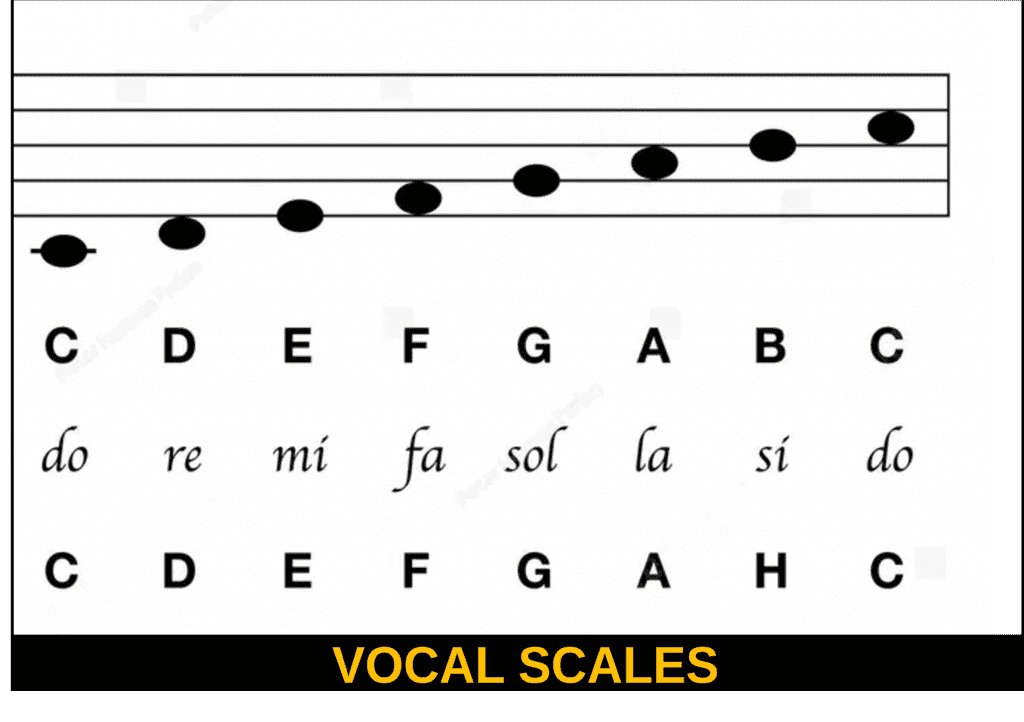
Think of a scale as a ‘vocal ladder.’
Each note is one step higher or lower than the last.
When you practice scales, you are teaching your voice how to move smoothly between notes and teaching your ear how each note should sound.
Scales help you:
- Match pitch more accurately
- Strengthen your vocal control
- Improve tone and consistency
- Build confidence when singing melodies
Step 1: Prepare Your Voice
Before singing scales, always warm up gently.
- Take a deep breath in through your pursed lips.
- Slowly release the air on a relaxed ‘Haaaa’ sound.
- Repeat this 3–5 times to wake up your breathing muscles.
Next, hum softly on a comfortable note. Keep your jaw loose and your lips gently closed. This prepares your voice without strain.
Step 2: Your First Scale (3-Note Scale)
We will start with a very simple scale using just three notes.
Sing this pattern:
Do – Re – Mi – Re – Do
You can use the syllable ‘laa’ or ‘oo’. Choose whichever feels easiest.
Tips:
- Start on a note that feels comfortable—not too high or too low
- Sing slowly and clearly
- Focus on matching each note, not rushing
Repeat this pattern several times before moving on.
Step 3: Learning to Recreate Notes
To recreate notes accurately:
- Listen carefully to the starting note.
- Pause for a second and imagine the sound in your head.
- Sing the note confidently, without sliding up to it.
If you miss the note, that’s okay. Stop, listen again, and try once more. Accuracy improves with repetition.
Step 4: 5-Note Scale Exercise
Once the 3-note scale feels comfortable, try a 5-note scale:
Do – Re – Mi – Fa – Sol – Fa – Mi – Re – Do
Sing this on ‘la’. Keep your volume even and your tone relaxed. Move up by one note each time if possible, but stop if your voice feels tight.
Step 5: Practice Tips for Beginners
- Practice for ten minutes a day
- Use a piano app or keyboard if available
- Always stop if your throat feels strained
- Consistency matters more than length
Final Thoughts
Scales may seem simple, but they are powerful. They train your voice and ear to work together, making singing feel easier and more natural over time. Be patient with yourself and enjoy the process. Every great singer started with scales, just like you are now.
Happy singing!