Singing Tips and Tricks for Beginners
Lesson Purpose
This taster lesson is designed to reveal how small technical adjustments can produce dramatic vocal improvements. Many singers struggle not because they lack talent, but because they are missing a single key understanding. These tips focus on efficiency, not effort.
VSL Harmonic Identity provides the solutions to your vocal difficulties. Think of this lesson as a precursor to a Question and Answer session.
We are providing some of the answers to questions that singers struggle with and didn’t want to take a course of lessons to find out. Or perhaps, you will find out that you were doing something wrong all along and the fix just took a minute.
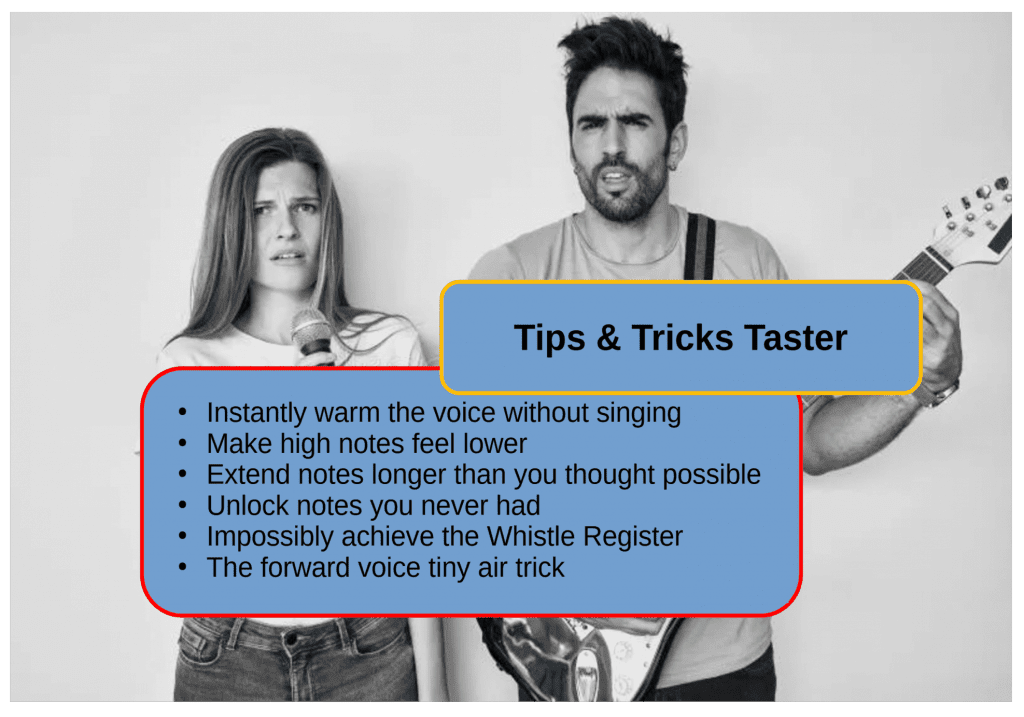
1. Instantly Warm the Voice Without Singing
To see how quickly that you can turn your voice around, sing a verse from a song and then do the same again after this exercise. The difference is mind blowing.
What you can achieve quickly:
A ready, responsive voice in under 60 seconds.
How:
- Firstly, imagine a Polo mint
- Next suck air into your throat, as if sucking air through the hole in the polo mint
- Then make sure that your mouth is wide and that there is much air flowing and cooling your throat
- Keep volume low and airflow steady
- Repeat as many times as you want to, but seven times in plenty.
This wakes up vocal resonance without strain and avoids the common mistake of ‘singing to warm up.’ Remember to hydrate with non fridge liquids.
2. Stabilise Shaky Notes in Seconds
What you can achieve quickly:
Immediate steadiness on sustained notes.
How:
- Slightly narrow the vowel (e.g. ‘ah’ toward ‘uh’)
- Alternatively widen your mouth towards a smile.
- Reduce air pressure instead of pushing more
- Works with any word. Try it.
Most instability is caused by excess air, not lack of support.
3. Make High Notes Feel Lower
What you can achieve quickly:
Less fear and tension on high notes.
How:
- Hum a succesion of notes upward and then back down
- Then go up an octave doing the same thing as above
- Keep humming the notes, going upward and then back down. Each time going an octave upwards, until, you hopefully realise you have been humming the elusive high note all along without realising it.
- Now sing that note and when you are able to, add it to your song
The body often tightens in anticipation. Singing a note without realising it, removes the block.
4. Increase Volume Without Strain
What you can achieve quickly:
A fuller, louder sound with no throat effort.
How:
- Imagine air swirling in your mouth as you breath out
- Let the breath widen as you widen your mouth
Power comes from resonance space, not force.
5. Extend Notes Longer Than You Thought Possible
What you can achieve quickly:
Longer phrases on one breath.
How:
- Breath in. Slowly allowing the lower ribs to expand and lift upwards. Keeping your chest relatively still.
- Next, slowly release the air, allowing the lower ribs to deflate downwards and in.
- Repeat this a few times to get the feel of it
- Then, when you breath in, feel the abdomen area/torso fill up, but also make sure that your lower ribs go up and out.
- Now, as you slowly release the air, sing the note outwards with the air
- Empty the air around the ribs first, then the air from the abdominal area/torso
Control is about air pacing, not lung size. You double the capacity of air, thus note length.
6. Instantly Improve Tone Quality
What you can achieve quickly:
A clearer, brighter, more pleasant sound.
How:
- Smile slightly with the eyes, or widen the mouth to a wide smile
- Allow cheekbones to lift
This subtly changes resonance placement without changing technique.
7. Reduce Vocal Fatigue Immediately
What you can achieve quickly:
Sing longer with less tiredness.
How:
- Lower volume by 10%
- Sing with swirling airflow in the mouth
Fatigue often comes from micro-tension, not overuse.
8. Unlock Notes You’ve ‘Never Had’
What you can achieve quickly:
Access to notes previously thought impossible.
How:
- Approach the note quietly first
- Remove volume and add it later
Range expands through coordination, not force. Not advisable for the highest notes.
9. Fix Breathiness Fast
What you can achieve quickly:
A more focused sound in minutes.
How:
- Add a ‘Q’ before your words
- Do so until it becomes inaudible, but you continue the process
These sounds automatically balance airflow.
Achieve the Impossible
The following two techniques are often considered ‘impossible’ because they require extreme coordination, precise muscle engagement, and a deep understanding of vocal anatomy. Extreme caution and professional guidance are advised when exploring these areas, as improper execution can lead to vocal fatigue or injury.
10. Achieve The Whistle Register (The Highest High)
The whistle register is the highest vocal register, produced when only the very edges of the vocal folds vibrate, often creating a sound similar to a flute or whistle.
- The Yawn-Sigh Method: Start with a silent, exaggerated yawn. As you sigh out, let a tiny, breathy sound escape. Slowly raise the pitch of this breathy sound, keeping the throat wide open. Keep repeating and going an octave higher each time.
11. The Tiny Air Trick
Singing ‘Hahhhhh.’ Imagine you are blowing a tiny stream of air through a pinhole. The sensation is one of minimal effort and maximum focus on the very front of the vocal mechanism. Avoid pushing from the diaphragm; the sound is generated by the resistance of the folds, not the force of the air. You are now achieving ‘Forward voice.’
Closing Insight
Many vocal breakthroughs happen not when something new is added, but when something unnecessary is removed. These tips work quickly because they focus on coordination, not conditioning. Contact VSL for precise help where you need it, instantly.
This taster lesson is not about perfection. It’s about showing what is possible – fast. – From Instant Warm-Ups to Mastering the ‘Impossible’
Lesson Purpose
This taster lesson is designed to reveal how small technical adjustments can produce dramatic vocal improvements. Many singers struggle not because they lack talent, but because they are missing a single key understanding. These tips focus on efficiency, not effort.
VSL Harmonic Identity provides the solutions to your vocal difficulties. Think of this lesson as a precursor to a Question and Answer session.
We are providing some of the answers to questions that singers struggle with and didn’t want to take a course of lessons to find out. Or perhaps, you will find out that you were doing something wrong all along and the fix just took a minute.
Enjoy…