
Advanced Singing Lessons
How to Sing With Chest Voice: Chest Voice Dominance
Lesson Objective
This advanced lesson focuses on mastering chest voice dominance. With healthy diaphragmatic support. You will refine power, stability, resonance control. As well as endurance. All without strain.
This is not about shouting or forcing volume, but about efficient breath management, optimal cord closure, and resonant placement that allows the chest voice to remain strong, flexible and sustainable across demanding repertoire.
1. Understanding Chest Voice at an Advanced Level
Chest voice is the lower and thicker-sounding vocal register that you use when you speak. Hence, creating a vibration that you can feel if you place your hand on your chest. This is the most natural and common register for both singing and speaking.
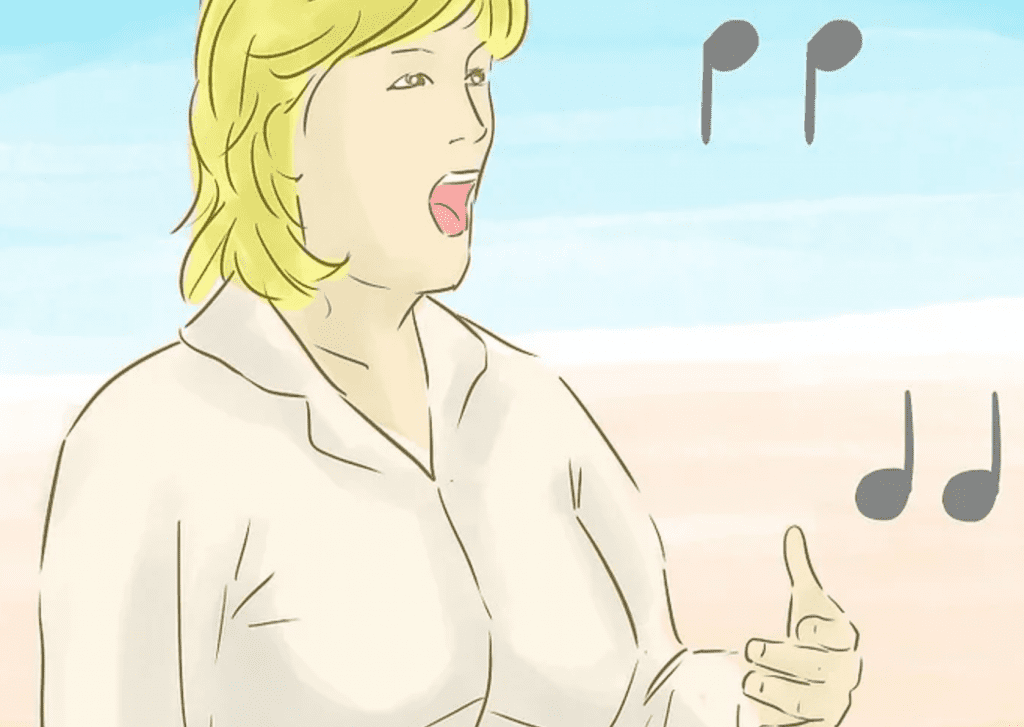
It’s called ‘chest voice’ because the sound resonates in your chest cavity.
Chest voice is characterised by thicker vocal fold engagement and a strong harmonic content. As well as a sensation of vibration in the sternum and lower throat. At an advanced level, chest voice should:
- Feel anchored and not pushed
- Remain responsive across dynamic changes
- Blend smoothly toward the passaggio without breaking
A common misconception is that chest voice comes from the chest itself. In reality, the sound is produced at the vocal folds; the chest sensation is resonance feedback, not the source of power.
2. The Role of the Diaphragm
The diaphragm is a large, dome-shaped, involuntary muscle. You can locate it at the base of the lungs under your rib cage. It plays a crucial role in breathing and supporting your voice when you sing.
When you inhale, your diaphragm expands and moves upward, creating space for your lungs to expand. When you exhale, the diaphragm relaxes and moves downward. Thus, helping to control the release of air.
Proper breath support from the diaphragm is essential for powerful and controlled singing. Advanced vocalism masters breath management through coordinated breathing techniques involving:
- Diaphragm
- Intercostal muscles (rib expansion and contraction)
- Abdominal muscles (controlled engagement, but never clenching)
Key Concept: Appoggio
Appoggio is the balance between breath pressure and vocal fold resistance. You should feel:
- Expansion around the lower ribs and back
- A steady, pressurised, controlled airflow
- Very little chest movement
3. Optimal Chest Voice Posture & Alignment
Advanced chest singing requires structural efficiency:
- Head balanced over spine
- Sternum comfortably lifted (not rigid)
- Neck and jaw released/relaxed
- Knees unlocked
- Legs at shoulder width
Poor alignment forces the throat to compensate, leading to strain and fatigue.
4. Advanced Breathing Drill (Silent Power Breath)
How to Sing from Your Chest/Diaphragm: A Step-by-Step Guide
Here is a step-by-step guide to help you master singing from your chest and diaphragm:
Step 1: Master Diaphragmatic Breathing
Before you can sing from your diaphragm, you need to learn how to breathe correctly. You will have covered this by now and will be expected to used your learnt knowledge to complete these exercises.
- Stand up straight with your shoulders relaxed. Inhale slowly through your pursed lips. Allow your abdomen area to expand. Exhale slowly through your mouth, feeling the area contract. Repeat a few times.
- Using the ‘Hot Potato’, breathe out a relieved breath. Breathing in and out four times.
- Now add vocals to the relieved breath. ‘Haa’, ‘Hee’, ‘Hoo’.
- Allowing no air before sound, sing a verse from a song.
- Keep practising, making sure you connect the breathing to the sound, as you have learned to do.
5. Chest Voice Strength Without Strain
Exercise: Anchored Sustain
- Choose a comfortable pitch in your range.
- Sing ‘Ahh’ at medium volume
- By now you should remember to add the ‘H’.
- Sing ‘Haaaah’. Air before sound.
- Maintain rib expansion while controlling the exhalation of the sound
- Don’t be afraid to use higher notes also
You should feel vibration in the chest at whatever pitch you begin at.
Exercise: Descending Power Scales
- Begin above your speaking range
- Descend on a 5-note scale ‘Yah’
- Allow thickness to increase naturally as pitch lowers
This builds chest dominance safely.
6. Managing Volume
True chest power comes from resonance efficiency, not force. Advanced singers control loudness by:
- Increasing resonance space (pharyngeal openness)
- Maintaining steady airflow
- Controlled projection
If volume increases but clarity decreases, you are overblowing.
7. Chest-to-Mix Preparation (Critical for Advanced Singers)
A strong chest voice must transition smoothly into mix. Practice:
- Projecting your voice at different volumes
- Reduced air pressure near the passaggio
- Maintaining support while releasing fold thickness
- Sing a song and maintain control over the chest voice
Chest voice mastery includes knowing when to let go.
8. Common Advanced Mistakes
- Locking the abs instead of coordinating them
- Over-darkening vowels to sound ‘powerful’
- Driving chest voice too high without modification
- Not breathing and misplacing air
- Using backward voice and missing the forward voice projection
Support feels stable and buoyant, never rigid.
9. Sensation Checklist (Healthy Chest Singing)
✔ Vibrations in chest and mouth
✔ Open throat sensation
✔ Steady breath flow
✔ No pain, scratchiness, or hoarseness
If discomfort appears, stop and reset.
Key Takeaway
Advanced chest voice is not built by force. It is refined through coordination, awareness and consistency. When breath, body, and resonance work together, chest voice becomes powerful, expressive, and sustainable.
Mastery is measured not by how loud you sing, but by how free and controlled you remain under pressure.
Advanced Stage Presence – A Masterclass
Revealing Presence Through Correct Performance
At an advanced level, stage presence is not something that you add. It already exists. What most performers lack is not presence, but clarity, control and permission to allow it to surface.
A vocalists stage presence isn’t separate from their performance. It is the physical and emotional embodiment of the song itself. It’s the difference between merely singing a song and truly living it in front of an audience. While your voice is the primary instrument, your entire being is the vessel for the music.
The core idea is to shift your focus from an internal monologue of anxiety to an external focus on your message and your audience. Advanced stage presence is about authentic connection, not just ‘performing.’
True presence emerges when voice, body, intention and awareness are aligned.
This lesson does not attempt to manufacture charisma. Instead, it removes the technical and psychological interference that blocks authentic presence.
1. The Foundation – Mastering Your Physicality
Your body communicates more than your words. An advanced performer has complete control over their physical self. They understand that presence begins before sound.
- Novice performers often fidget or move aimlessly. An advanced performer makes every movement deliberate and purposeful.
- The stage is your canvas. Don’t just stand in one spot. Assign different parts of your vocals to different areas of the stage. For example, you might introduce your song at centre stage. Begin and then walk to the right to emphasis the words and then slowly to the left, to take the audience on the journey with you. This creates a more dynamic and visually engaging experience for the audience.
Exercise
Perform a full song allowing yourself only three intentional movements. Each movement must be musically justified.
Key Takeaway
Stillness creates authority. Movement without purpose weakens presence. When you move, it must be because the music demands it – not because you feel exposed.
2. The Connection
The audience isn’t a passive observer; they are your scene partner.
- Your body is the framework that supports your voice. An advanced singer uses their body to serve the song, not distract from it. This is non-negotiable for both vocal presence.
- Charisma is often seen as a mysterious quality, but it can be broken down into components like confidence, passion and expressiveness. It’s the ability to make others feel that you have something special to offer. Your presence needs to be a focused energy that you share with the audience.
- Many vocalists fail to convey their charisma by not knowing what to do with their hands. Fidgeting or stiff arms can signal nervousness and stop the connection that could have been had with the audience.
Engaging the Audience
- Don’t just scan the room. Eye contact is more about about projecting intention through the eyes, than looking at people. Hold eye contact with one person for a full thought or sentence. This creates a moment of genuine connection. Then, move to another person in a different section of the room. Thus, allowing individuals to feel seen and makes the entire audience feel included. If you are unable to look anyone in the eye without feeling anxious, then look at the space between their eyes, on their forehead. They will still think that you are looking at them.
- Ultimately, your voice is an instrument. Vary your pitch, volume and pacing to create interest and convey emotion through your vocal dynamics.
Exercise
- Record yourself practising. Before you even step on stage, adopt a power pose for two minutes. Standing tall, with your feet apart, hands on your hips and chin up, with your head held high. For the first two minutes, stand completely still. Then, allow yourself to make only three distinct gestures or movements during your vocals. Nod your head towards your imaginary audience, or gesture a word from the song. Whatever you are comfortable with. This forces you to choose movements that emphasise your points, rather than distracting from them. Your movement should be motivated by the song’s narrative and energy.
- Imagine you are inside a large bubble. As you sing, practice using your hands and arms to ‘paint’ the music on the inside of this bubble. Let your gestures flow from the emotion of the lyrics. A soaring high note might inspire an upward, open gesture. A quiet, intimate phrase might bring your hands closer to your chest. The goal is for the gesture to feel like a natural extension of the sound.
Key Takeaway
Presence is often strongest between phrases, not during them.
3. Internal Focus – External Awareness
Weak presence comes from self-monitoring. Strong presence comes from outward attention.
The audience connects with emotion. An advanced performer doesn’t just show emotion; they feel it and let the audience witness that experience. You bring your audience on your journey. Even if it’s only a three minute song.
- Before you sing a song, you must know what it’s about for you.
- Answer these questions for every song: Who am I singing to? What do I desperately want them to know or feel? What just happened before the song began? What will happen if I fail to get my message across?

Having this clear subtext will inform every note you sing and every look you give. Your performance becomes a scene and you are the lead character. With your eyes being the most powerful tool for connection.
Your face must match the emotional tone of the lyric. Tension in the jaw, forehead, or neck not only hinders vocal technique but also creates a mask that prevents the audience from seeing your true emotion.
Exercise
Here are other exercises that teache you to connect externally, while deliberately ignoring any internal conflicts.
- Instead of scanning the crowd, which connects with no one, think of yourself as a lighthouse. Focus your gaze on one small section of the audience (or one friendly face) for a full musical phrase. Let them feel the full weight of that line. Then, slowly and deliberately, move your ‘light. to another section for the next phrase. This creates intimate, personal moments with the entire room.
- Sing your song in front of a mirror. Are you raising your eyebrows in a tense way on high notes? Is your jaw tight? Practice relaxing these muscles so your face is free to express the genuine emotion of the song. A relaxed, expressive face is key to both better singing and better presence.
4. The Performer’s Mindset
Your internal state dictates your external performance. Confidence is a choice and a practice.
- Embrace the Adrenaline. The nervous energy you feel is the same energy that fuels legendary performances. It’s your body giving you the fuel you need to be extraordinary.
- Shift your focus from being judged to giving a gift. You have prepared, you have practised and now you are here to give the gift of this song to the audience. This changes the dynamic from a test you might fail into a generous act. Your goal is to move them, to give them an experience.
Owning the Stage
- No matter how many times you’ve rehearsed, you must perform the song as if you are discovering the thoughts and feelings for the very first time. Right there on stage. This creates a sense of immediacy and authenticity that is absolutely magnetic. The audience will feel like they are witnessing something special and unique.
- Adopt the practise of walking from heel to toe. Thus, avoiding any trips over any microphone or musical wires.
- Keep your performance movements relevant. A concert calls for more movement, but a church would call for more.
- Walk purposefully and confidently, without a hint of arrogance. Always have an introduction ready, in case you are asked to or have not been introduced.
- Employ the correct singing techniques, as in VSL Harmonic Identity Lessons.
By integrating these physical, emotional and mental practices, your stage presence will become a seamless and powerful extension of your voice. Transforming your performances from simple recitals into unforgettable experiences.
Key Takeaway
Reframe it in your mind: “This isn’t fear, this is my power source. I am ready.”
Emotion should be contained, not displayed. The audience leans in when you withhold slightly. Overacting kills mystery and mystery is power. That said, no one has been grudged for a silent tear.
5. Ownership of Space
Advanced performers do not ‘fill’ a stage—they claim it.
- Walk with purpose.
- Stop with certainty.
- Stand as if the space belongs to you.
If you believe you belong there, the audience will agree.
Key Takeaway
Stage presence cannot be taught because it is not a technique.
But correct performance removes fear, distraction and excess, allowing presence to appear naturally.
When technique is secure and intention is clear, presence is unavoidable.
You do not need to become someone else on stage. You only need to stop getting in your own way.
Key principle:
Convey less. Mean more.
Projection for Singing and Speaking:
Reaching the Back of the Room
Please complete the Vocal Control, Performance Preparation, Vocalists Alphabet Lesson and Breathing Techniques before starting this lesson. You will better understand how to achieve vocal projection.
Welcome to this comprehensive lesson on Vocal Projection. Whether you are a singer on a stage or a speaker in a boardroom, the ability to project your voice is one of the most vital skills you can possess.
Many people confuse ‘projecting’ with ‘shouting.’ However, they are fundamentally different. Shouting is a throat-based action that causes strain and fatigue. Projection is a body-based action that uses air and resonance to propel your sound forward with clarity and power.

Our goal for this lesson, is to teach you how to reach the person at the back of the room without ever having to shout.
We aim to convey the reality that projection for vocalists mean achieving a clearer, more focused and efficient sound. VSL teaches you that projection has the ability to control your sound as you propel it forward. Allowing your voice to reach the person at the back of the room without shouting.
True projection protects the voice while increasing its impact, as originally taught via the Eugene Technique.
Projection Is Not Volume
Shouting forces sound outward using throat tension. Which leads to fatigue, strain and inconsistency. Proper projection, on the other hand, relies on breath support, resonance and direction. When these elements are aligned, the voice travels naturally and effortlessly.
A projected voice feels easy to produce, even though it carries far.
Breath as the Engine
Think of breath as the engine, not something you push, but something that sustains movement. Without a steady stream of air, your voice has no ‘fuel’ to travel.
Projection begins with controlled breath in the core, not the throat. Rather than lifting the shoulders or forcing air, the breath should expand low into the ribs and abdomen. This creates a stable airflow that supports the sound from underneath. When the breath is steady, the voice can remain relaxed and focused.
Resonance and Forward Placement
To project effectively, sound must be allowed to resonate. This happens when the throat remains open and the sound is directed forward, outwards. Rather than trapped in the chest or throat.
Sound is like light; it can be scattered or focused. Projection is about focusing your sound into a ‘beam’ that travels.
1. Directing the Sound
- Imagine your voice travelling over the heads of the audience. In a straight line and hitting the wall behind them. Not being thrown and hitting them. Thus, you see that the lift, clarity and reach achieved by projection.
- Don’t just speak at the people in front of you. Aim your voice at a specific point at the very back of the room, such as a clock, a door, or a person.
- Also, imagine your voice is a physical object that you are ‘throwing’ to that distant point. If you aim for the back, the people in the front will still hear you perfectly, but the sound will have the momentum it needs to travel.
2. Crisp Articulation
Mumbling is the enemy of projection. If your consonants (T, K, P, B) are lazy, your voice will sound like a muffled blur, no matter how loud you are.
Clarity Over Force
Projection improves dramatically when articulation is clear. Consonants shape the sound and vowels carry it. A well-articulated phrase will project further than a louder, poorly shaped one.
The goal is audibility with ease, not dominance through volume.
Practical Projection Exercises
Practice ‘over-articulating’ your words apply what you learnt from the Hot Potato and Vocalists Alphabet Lesson. Exaggerate the movement of your lips and tongue. This clarity ensures that your message remains intelligible even at a distance.
- Imagine you see a friend across a busy street. Call out ‘Hey!’ using your belly muscles to push the sound, as learned in the Breathing Techniques Lesson. Always, air before sound.
- Note the difference to shouting. It should feel ‘supported’ and not scratchy in your throat.
- Start by speaking a sentence to someone 2 feet away. Then, imagine they move to 10 feet, then 30 feet, then 50 feet.
- The Wall Bounce: Stand facing a wall about 10 feet away. Find a visible spot at eye level. Speak or sing ‘Ha’ using the force of your abdominal muscles. Push the sound out and hit the spot that you identified. Try to ‘feel’ the sound bounce off the wall and come back to you. If you can feel the vibration returning, you are projecting effectively. Repeat this four times.
- Continue until projection is second nature.
You may feel as if you are shouting, but we have given you the tools to control that.
Conclusion
Projection is a physical skill that requires coordination between your breath, your resonance and your focus. By shifting the work from your throat to your core, you can command any room with a voice that is powerful and clear.
Key Takeaway
If you can reach the back of the room without shouting, you are projecting – not forcing.
Coordinated Singing Skills:
Advanced Integration of Breath, Support & Sound
Essentially, Coordinating Singing Skills involves connecting abdomen breathing with respiration. Also, connecting respiration with sound and warm ups with tuning. All while making sure that is so well coordinated that you do not suffer air displacement and so on.
The end result will be regular practise of learnt skills in order to connect each skill, then regular exercises to tune the voice.
At this advanced level, the VSL Harmonic Identity has evolved into technical knowledge, but conversely that is no longer the goal – coordination is. You have already developed awareness of abdominal breathing, support management, resonance shaping, diction clarity and tonal control, among other skills.

This lesson focuses on integrating those elements into a unified vocal function and aims to be the missing link between you feeling as if you ‘get it’ and knowing that you actually do. Then repeating it again and again, on purpose.
Coordination is the point at which separate technical skills cease to feel separate. Breath is no longer something you ‘do’ properly before and during singing. Support is no longer something you ‘apply.’ Sound emerges as the natural result of a coordinated system.
This lesson is about building that system and knowing how to do it, on purpose.
1. Understanding Coordination
Coordination in singing means:
-
Breath responding to sound
-
Abdominal engagement responding to airflow
-
Resonance adjusting without excess muscular effort
-
Tone emerging without forced air displacement
-
Technique serving expression rather than interrupting it
At this advanced level, you, the singers’ task is to remove unnecessary interference. The body must learn to stabilise airflow while allowing phonation to occur efficiently.
Key Takeaway
Your breating energy must be connected to tone production — not pushed into it.
2. Reconnecting Abdominal Breathing to Sound
Abdominal breathing alone is not sufficient. Many advanced singers over-breathe or over-control.

Activity One: Silent Coordination
-
Inhale allowing the lower abdominal region and lower ribs to expand naturally (balloon in straw method).
-
Suspend briefly without locking.
-
Release the breath on a silent ‘ah’ shape – but without phonation and relax.
-
Observe whether your abdomen collapses suddenly or releases gradually.
The goal is measured release, not collapse. You have learnt control in previous lessons, so now, you will learn to use that control further.
Activity Two: Adding Tone Without Air Displacement
Now introduce tone:
-
Inhale as before.
-
Begin phonation gently on a sustained vowel (e.g., ‘oo’ or ‘ee’).
-
Monitor your diaphragm and abdominal wall.
-
Your abdomen area should remain responsive, but not rigid.
-
The sound should begin without a burst of air.
-
Remember, inhale with your diaphragm and area up/out. Exhale with your diaphragm and area down/in.
If you feel the air pushing outward or escaping before tone stabilises, reduce your breath intake.
At this advanced level, more air is rarely the solution.
3. Warm-Ups Without Excess Air
Many singers mistake airflow for support. Warm-ups in this lesson must emphasise economy of air.
Exercise: Controlled Onset on a Single Pitch
-
Sustain a comfortable mid-range note with phonation.
-
At this stage, it goes without saying that with breathing in and out, comes before practising any phonation. Begin the tone after breathing out, with minimal air leakage.
-
Maintain consistent resonance without volume increase.
-
Sustain that control for 6–8 seconds.
-
Repeat on adjacent notes.
Focus on:
-
Stability and control
-
Even airflow
-
No visible chest collapse
-
No abdominal thrust
Key Takeaway
You would or should not begin a conversation with a sharp intake of breath and then speak on top of the full of air lungs. Try it, you will sound strange. By the same token, you do not take a sharp intake of breath and then sing. You will begin relaxed and use the relaxed or relieved breath to begin singing. Start how you mean to continue and the sound will be of a better quality.
Exercise: Semi-Occluded Coordination
Lip trills or light ‘vv’ sounds are useful here.
-
Glide gently through a five-note scale. (ahhh…)
-
Maintain a consistent controlled airflow.
-
Ensure that your abdominal engages and adjusts gradually, not abruptly.
This trains the body to regulate breath automatically.
Key Takeaway
At this advanced level of practise, you should have been doing your breathing exercises to warm up, before singing and so on. Have you noticed that you are breathing from your abdomen? If so, great! VSL has done what we set out to do. Not just show you how to be a singer, but show you how a singer immerses into that role.
4. Integrating Learned Skills
Now begin layering previously learned elements:
-
Breath awareness
-
Support regulation
-
Vowel shaping
-
Diction clarity
-
Resonance placement
Choose a simple phrase from repertoire.
Sing it at 60% intensity and observe:
-
Does your breath remain stable and controlled through consonants?
-
Does abdominal support disengage at the end of phrases?
-
Is there excess air on initial vowels?
-
Does resonance shift when diction increases?
-
Are you engaging your Singers Alphabet knowledge with ease?
Reduce your tempo if necessary. Coordination improves through slow, conscious repetition.
5. Practising for Integration
Advanced coordination develops through deliberate repetition. We hope that we have stressed the need for practise enough.
Structured Practise Model
1: Isolate
Work briefly on one element (e.g., breath stability).
2: Layer
Add tone production.
3: Integrate
Add diction (singers alphabet) and dynamic variation.
4: Project
Add your forward voice for the professional touch.
5: Apply
Apply your skills within each musical context.
Repeat regularly until your body no longer treats these as separate tasks.
6. Regular Exercises to Tune the Voice
Daily coordination exercises should include:
-
Sustained tone with a controlled abdominal response
-
Gentle scale work maintaining consistent controlled airflow
-
Controlled dynamic variation without breath collapse
-
Phrase singing at reduced volume before full intensity
The purpose is not vocal strength, but responsiveness.
Over time, your voice becomes:
-
Efficient
-
Stable
-
Flexible
-
Expressive without force
7. The End Result
When coordination is achieved:
-
Your breath and sound are inseparable.
-
Your abdominal engagement responds automatically through muscle memory.
-
Warm-ups feel efficient, not effortful.
-
Your tone begins cleanly without air push, yet never without air present.
-
Your vocal expression becomes easier.
Key Takeaway
As an advanced singer, you no longer ‘apply the technique.’
The technique operates as a unified system.
Coordination is not achieved in a single session. It is reinforced through consistent, mindful practise. Your voice must be trained to respond automatically under musical demand.
- How to Sing With Chest Voice
- Performance Preparation
- Stage Presence for Singers
- Pitch Accuracy When Singing
- Projection for Singing & Speaking
- Coordinated Singing Skills